
Money, offices and ranks
Updated
Money is the fail state in Hollywood Agent. The studio's systems line says it in one sentence: "Run out of money and it is game over." Steam's feature list puts the same rule inside agency finances: commissions, fixed costs, office upgrades, a detailed cash ledger, and a credit line with deadlines. The game is unreleased, so the amounts in the screenshots are the staged month those images show, not a published starting budget. Read the monthly loop for where the cash comes from, and casting and reviews for the fee-or-share choice that feeds the ledger.
The English Agency screen is the ledger you can see. Tabs read Finances, Ledger, Office, and Rank and goals. The Finances view shows four headline tiles: cash, a credit line, costs per month, and how many months the agency has lasted. Under that, monthly fixed costs are itemized as office and staff, scouting programs, and coach salaries, with a total. The current-month column shows commission income against those fixed costs and a projected net. The room behind the panel is the same painted desk as the rest of the English shots: phone, paper stack, headshots, lamp, and a director's chair by the window.
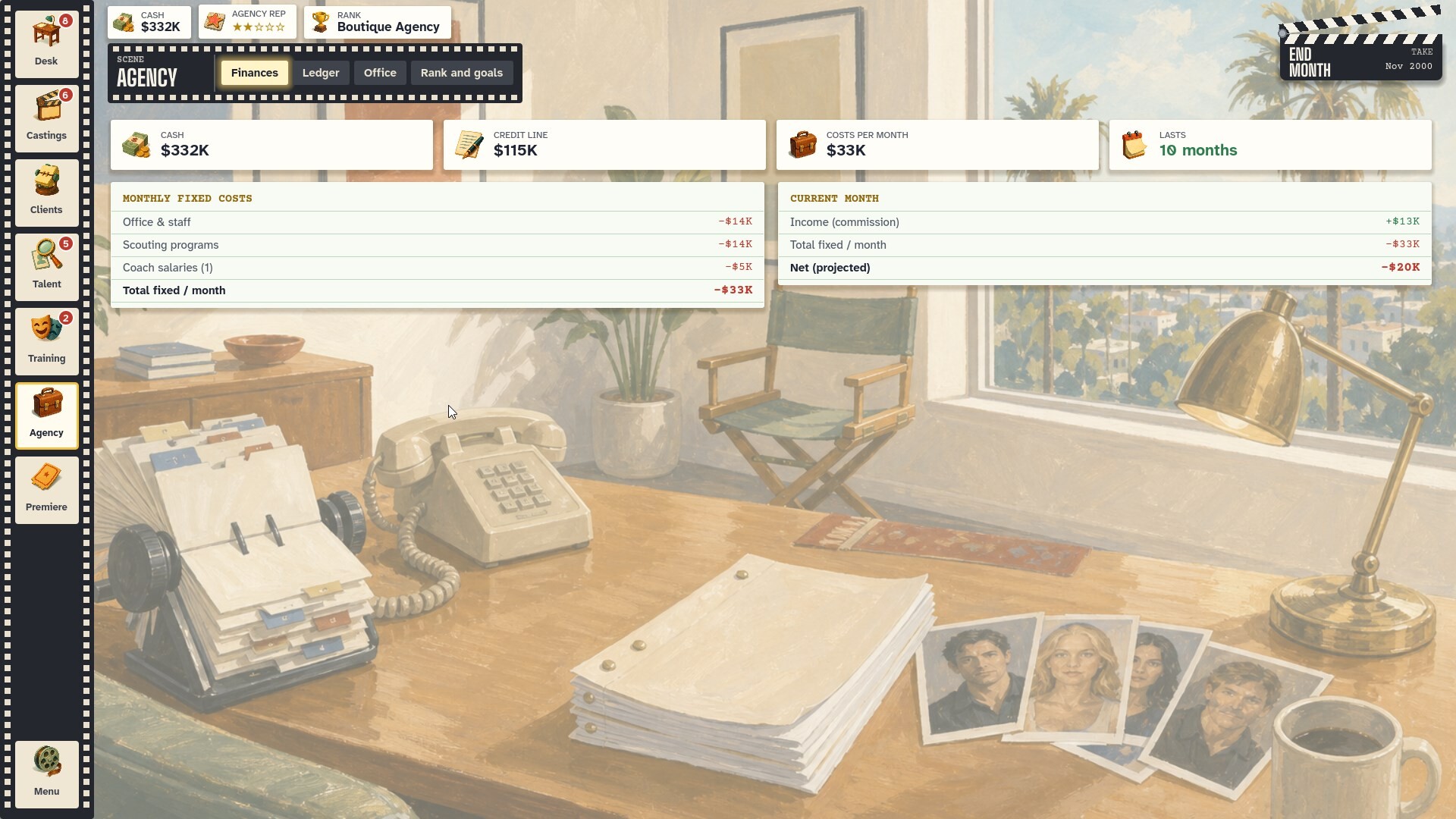
What the month spends and what it earns
Income, in the announced design, is the cut you negotiate. Steam's short description says you negotiate your cut. The Premiere news line in the screenshots records a fee and a commission as separate figures, which matches a client payment and an agency share. Fixed costs are the ones the finances panel names: the office, scouting, and coaches. Signing and training is why those last two exist. Scouts bring the prospects. Coaches are the specialized trainers the develop text tells you to hire, and their cost rises as skills improve.
The credit line is announced with deadlines. The screenshot shows it as a tile next to cash, not as a vague loan you can ignore. A projected net that is negative is the month the credit line is for. The studio also offers difficulty "from a relaxed career to an unforgiving business," so the same cost structure can be tuned. The fail state stays the fail state on either setting. When the cash and the credit line are both gone, the announced result is that the game ends.
The Desk screenshot adds a small running summary above the calendar: costs per month, how long the agency has lasted, and last month's result. The calendar itself is full of commitments that are also costs in time: filming, decisions, premieres, and a client who is away. A month that looks profitable on the commission tile can still be the month a client is unavailable. That is the link to casting. A profit share instead of a fee, which the land-roles text offers, moves money out of this month and into whatever the box office later does. Take the fee when the projected net is the problem. Take the share when fame, which the career text says unlocks better deals, is the point.
Offices, from the back room to the tower
Progression is an office and a rank. Steam says you start in a small office and work up through Hollywood's ranks. The studio is more specific about the bottom and the top: start in a rented back room, then bigger offices, on the way to an agency talent wants to join. The feature list calls the steps office upgrades.
The German office screen shows that ladder as five named rooms. Hinterzimmer is the back room. Boutique-Büro is the boutique office. Etage in Burbank is marked as the current office in that screenshot. Suite am Sunset Boulevard and Tower in Century City sit above it, and the higher rooms carry a rank requirement on the button. The screen's own paragraph says a new rank unlocks a larger office, that moving is your decision, and that a larger office costs more, looks after more clients without an added charge, has room for more coaches, and brings more projects onto the board. Those rent chips and client caps are small type in one marketing screenshot. The names of the rooms and the direction of the climb match the studio's "back room to a tower" line. The exact rents belong to the build, which is not released, so they stay in the picture.
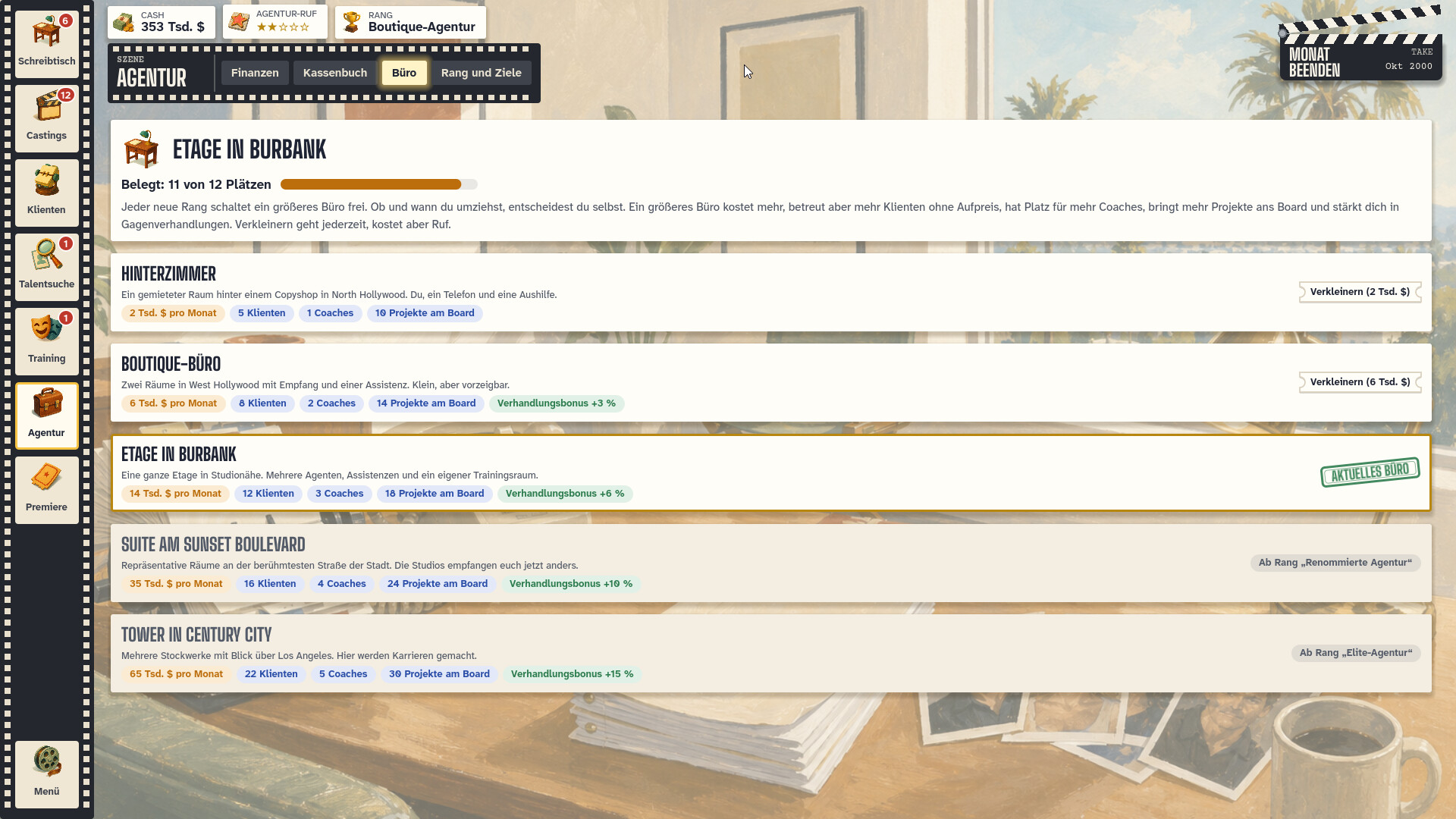
Ranks have their own screen in the German set, a ladder with the current rank called Boutique-Agentur, the same rank the English top bar calls Boutique Agency. Reputation thresholds sit on the later rungs. Again, the existence of a rank ladder is what the screenshot establishes. The numbers on the rungs are part of that image, and the release plan is the reason not to treat a marketing screenshot as the shipping balance.
The art page is worth opening next to this one, because the office you are upgrading is also the painted room the interface sits on. The desk, the phone, and the headshots do not change when the panel says the agency moved to Burbank. The rank and the room list are the progression. The painting is the style.
Verdict: Watch the projected net and the credit line before you chase a bigger office. The announced game over is an empty account, and a larger room is a larger fixed cost.
FAQ
Is bankruptcy the only way to lose?
It is the fail state the studio states outright. Scandals and bad reviews change careers, and the store text says a signing can make or break one, but the sentence that ends the game is the money sentence.
Do I have to take the bigger office?
The office screen says moving is your decision, and it also says the larger office costs more. A rank can gate the move. Skipping a room that would sink the month fits the announced rule.
What is the credit line for?
Steam lists it with deadlines next to the cash ledger. The finances panel shows it as a balance beside cash. It is the announced bridge across a month whose fixed costs beat the commissions.
Are the dollar figures in the screenshots the real economy?
They are the figures printed on the official marketing images for one staged month. The studio has published the categories, commissions, fixed costs, the credit line, and the game-over rule. It has not published those screenshot totals as the starting rules.
Sources: Steam store feature list, Highground game page, official Steam screenshots