
Signing actors and training them
Updated
Signing in Hollywood Agent is a monthly talent market, and training is how a signed actor becomes someone a studio will hire. Both systems are announced on the Steam about text and on the studio's game page. The game is unreleased, so the pages below describe the disclosed loop and what the official screenshots show of it. They are not a build order from a played campaign. Start with the monthly loop if you want the whole turn in one pass, and with casting and reviews when the client is ready to audition.
Steam's discover text is the roster rule: new actors apply every month, scouts find more prospects, and each person has skills, a background, a home country, languages, an accent, special abilities, and a personality. They also have ambitions, preferences, and roles they refuse. The studio's shorter version is the same job: spot potential before anyone else does. The feature list calls them living actors, with relationships that evolve as they age and respond to how you treat them.
Applications, scouting, and poaching
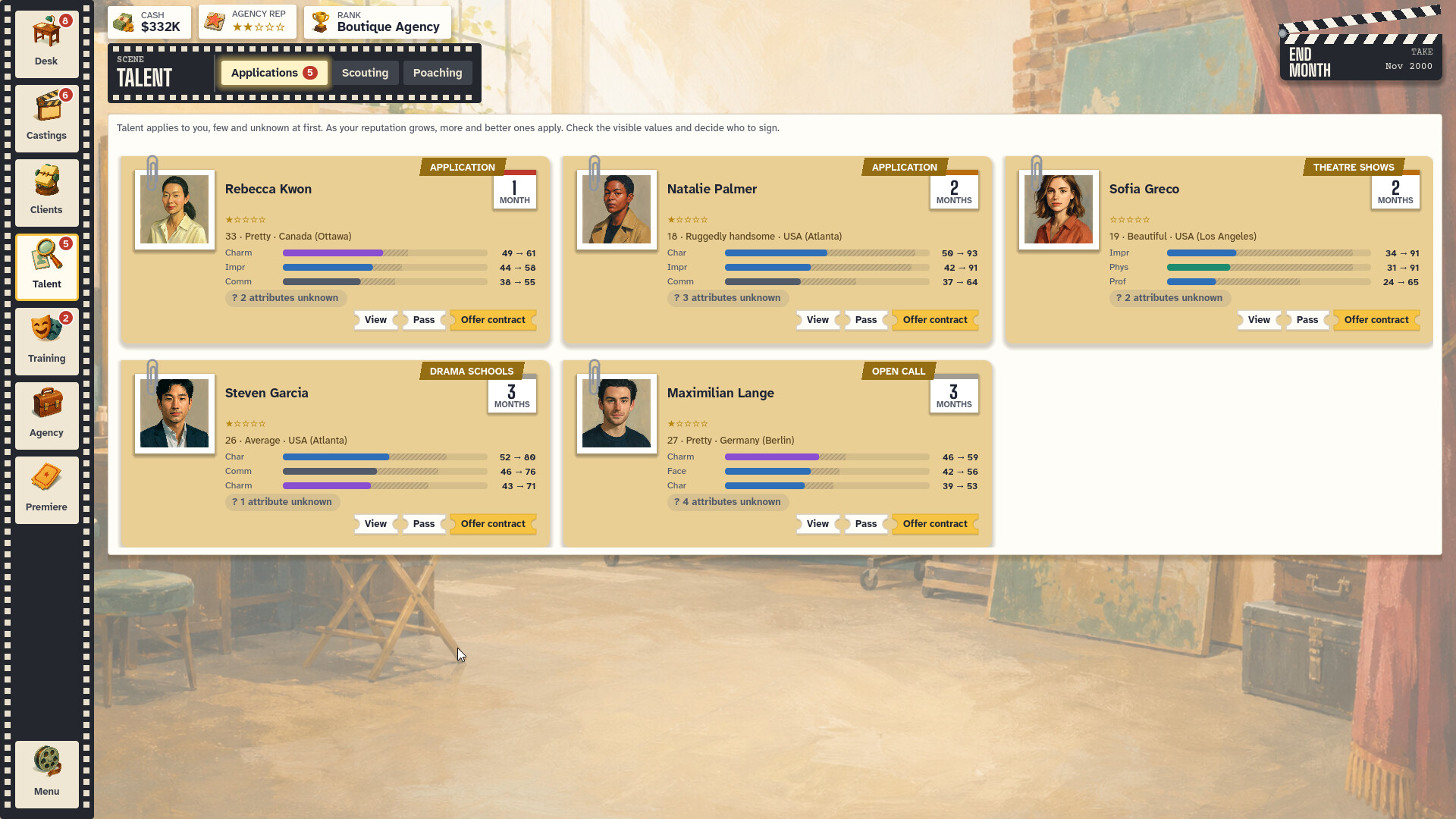
The Talent screenshot's own caption says talent applies to you, few and unknown at first, and that a stronger reputation brings more and better applicants. It tells you to check the visible values and decide who to sign. That matches the store text, and it explains the "attributes unknown" line on the cards. You are buying a person you can only partly see.
The three tabs are Applications, Scouting, and Poaching. Scouting is the on-screen name for the scouts the store text already promises. Poaching lines up with the contract rule that rivals already represent some of the best talent and that you can buy out their contracts. They can do the same to yours. Steam's rival feature says those agencies build their own rosters, fight you for roles, and attempt to poach your clients. A buyout is a disclosed action. The fee printed on any one card in a screenshot is an example in that image, not a published price list.
One offer at a time
The negotiation rule is short and strict. Offers go out one at a time. Push too hard and the actor walks. Offer too much and the margin shrinks. Steam describes the same conversation as round-by-round negotiation. The Talent cards put Offer contract next to Pass, which is the visible version of that one-offer gate: you choose a person, you make a bid, and the bid can fail.
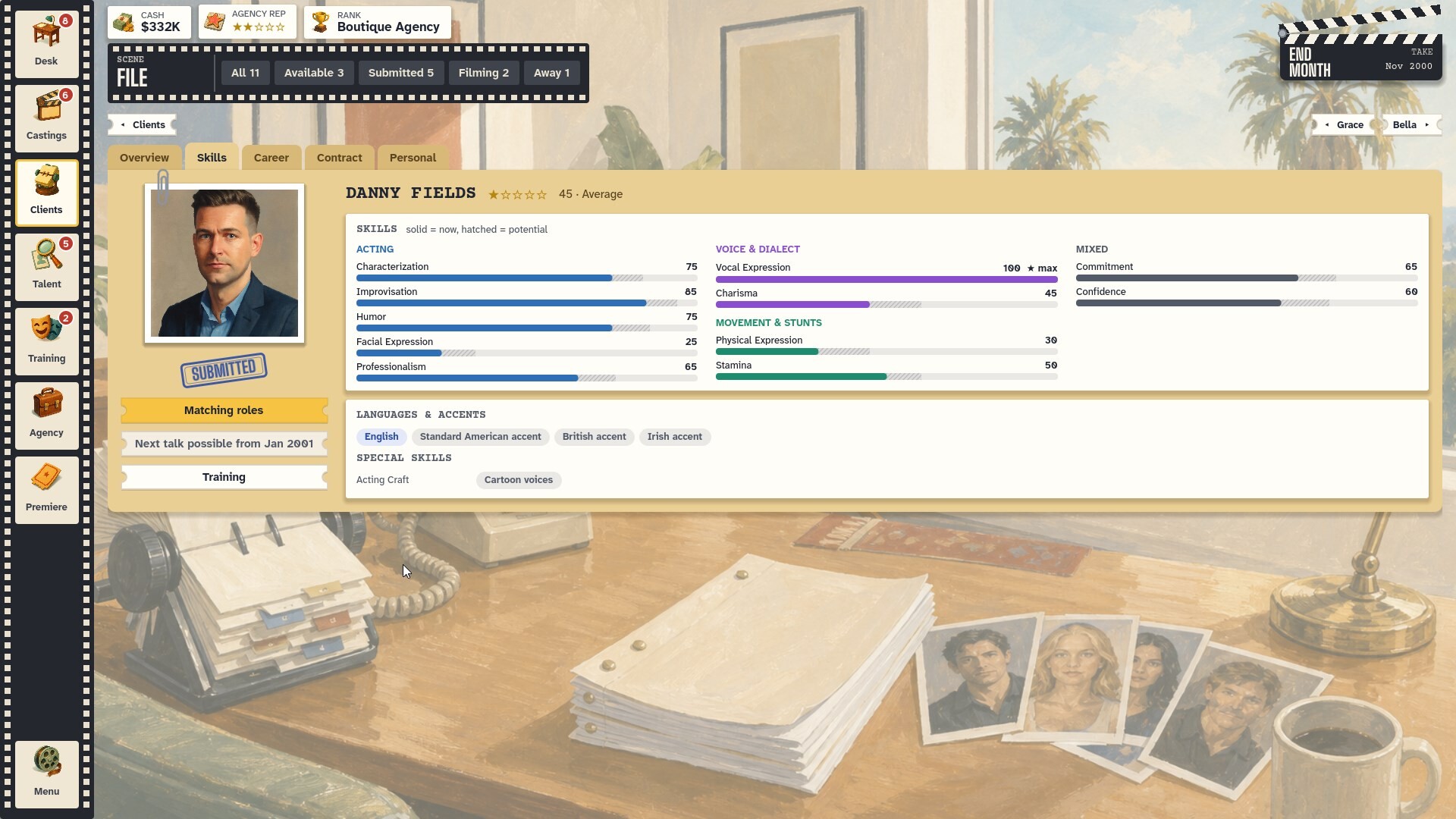
Once someone is signed, the client file is a folder. The English file for Danny Fields, one of the portraits also pinned on the Desk, has tabs for Overview, Skills, Career, Contract, and Personal. The page shows skill groups for acting, voice and dialect, movement and stunts, and a mixed set that includes commitment and confidence. It also lists languages and accents, and special skills such as acting craft and cartoon voices. A Submitted stamp sits on that particular file, and a note says the next talk is months away. Those are details of one marketing screenshot. They show that a signed client has a contract tab, a skill page, and a calendar for the next conversation. They do not publish Danny Fields as a starter character you are guaranteed to meet.
Coaches, courses, and mood
Training spends points on specific skills. You hire specialized coaches and send actors on courses to learn new abilities. Costs rise as skills improve. The studio's develop text adds the human half: talk to clients, respect preferences, and monitor mood. Ambitions change, and neglected clients become difficult to manage.
The Training screenshot makes that operational. The tabs are Actors, Coaches, and Market. Each actor row has skill boxes with a cost in experience and a state labeled coach limit when a box will not take more. One row is paused, with the reason written on the screen: not available because of a shoot, an injury, or an appointment, and no experience while paused. Another actor can be left with no coach group. The image also shows a top strip of two agency-wide bars, professionalism and confidence, separate from any one client.
That pause matters for the month. A client who is filming is not also in class, which ties training to the casting calendar. A client you never speak to is the neglected client the store text warns you about. The content notes are the right page for the optional storyline about addiction and rehab. That material is text, and it sits next to mood and personal events rather than next to the skill bars.
The money page is where coach salaries show up as a fixed monthly cost. Training is not free in the announced economy, and the same screenshot set shows a coach line inside the agency's monthly costs.
Verdict: Sign on the visible bars, expect hidden attributes, and make one offer at a time. Keep a coach on the people you need next month, and read a paused row as a client who is busy, hurt, or booked.
FAQ
Can I scout and poach in the same month?
The Talent screen shows both as tabs next to Applications, and the store text describes scouts and buyouts as ongoing tools. How many actions fit in one month is part of the unreleased balance.
What happens if I overbid?
The announced result is a thinner margin. The announced result of pushing too hard is that the actor walks. Those are the two failure directions the studio names.
Do clients refuse work?
Steam says they have roles they refuse to take, plus preferences and changing ambitions. Matching a client to a part is the casting page's problem, and the refusal is a reason a match can be wrong.
Is there a full skill formula?
The screenshots show named skills and bars. The studio has not published the formulas behind the bars. Use the groups you can see: acting, voice, movement, and the personal stats such as confidence.
Sources: Steam store about text, Highground game page, official Steam screenshots